
Why Testing Is Not Proof: Neural Network Certification
On this page
Certification Series
Reader background. We assume undergraduate calculus, linear algebra, elementary probability, and basic neural networks. The series introduces program verification and neural network certification from first principles.
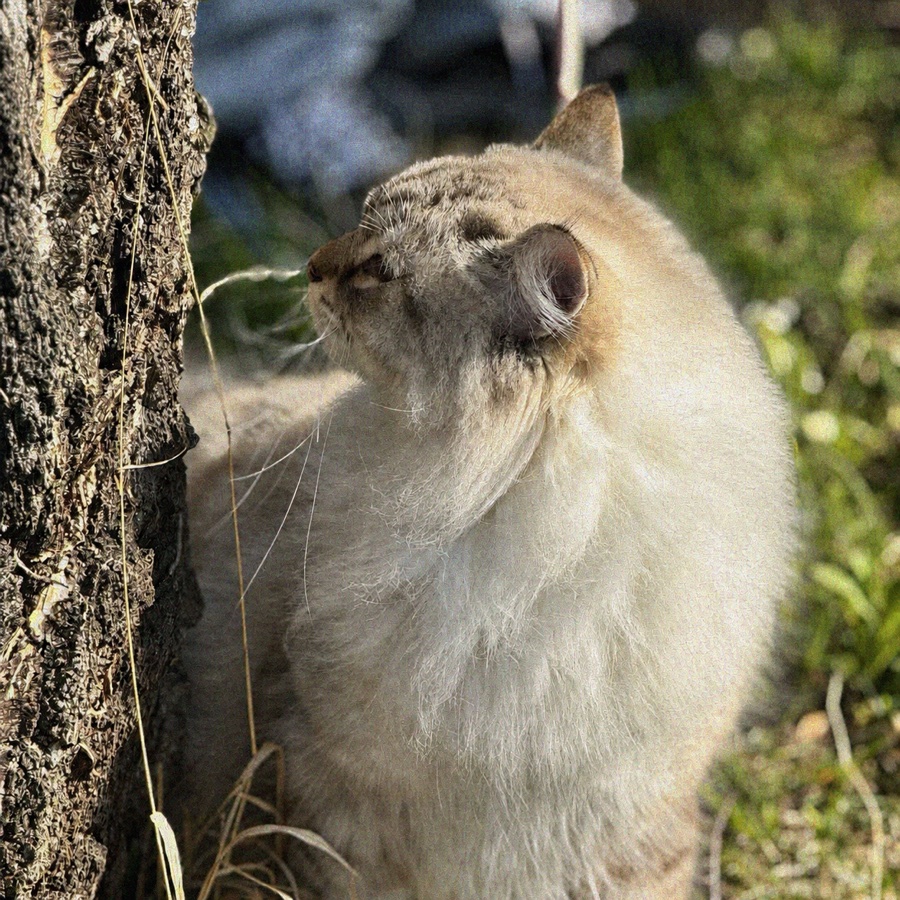
Meet April, my Siberian cat.

Imagine that an image classifier receives this photo and predicts cat. The prediction is correct for this input. Now darken the photo, compress it, add camera noise, or change a few pixels. Will the prediction remain cat?
Why models need to be robust
Suppose our classifier labels 9,800 of 10,000 test images correctly, giving 98% test accuracy. That aggregate measure does not tell us whether a correct prediction will survive nearby changes.
The same scene can reach the model through different cameras, lighting conditions, compression settings, and preprocessing pipelines. We still see April, but the classifier receives a different array of numbers each time.
A robust model preserves the required behavior when the input changes in ways we have decided to allow. This raises two concrete questions:
- Which input changes should we consider?
- Which model behavior should remain unchanged?
For April’s photo, we may require the predicted class to remain cat under a specified amount of image noise. Another task might allow small rotations rather than pixel noise. A regression task might instead require a numerical output to remain within a safe range. The word robust is incomplete until we answer both questions.
From robustness to adversarial robustness
Random sensor noise is not chosen with the classifier in mind. An adversarial perturbation is chosen specifically to make the classifier fail. Adversarial robustness therefore asks a worst-case question:
Can someone deliberately choose an allowed change to April’s photo that makes the classifier stop predicting cat?
An allowed image that changes the prediction is an adversarial example. Research on adversarial examples showed that small, carefully chosen perturbations can change neural network predictions. The robust optimization viewpoint frames robustness through performance under the worst allowed perturbation. This worst-case target motivates adversarial attacks, which search for an allowed failure.
Restricting which changes are allowed prevents a trivial attack. Replacing April’s photo with a photo of a dog might change the prediction, but it tells us nothing about whether the classifier is stable near the original photo. A threat model draws this boundary by stating what may change, by how much, and what counts as a successful attack.
Let $x_0$ represent April’s photo, with pixel values normalized to $[0,1]$. We measure a pixel perturbation with an $\ell_p$ norm, where $1\leq p\leq\infty$, and limit its size with a radius $\epsilon$. The allowed images therefore form the set
\[S_p(x_0,\epsilon) =\left\{x\in[0,1]^d:\lVert x-x_0\rVert_p\leq\epsilon\right\}.\]Here, $d$ counts all pixel values across all color channels, and $p$ determines how their changes are combined. When $p=\infty$, the norm measures the largest absolute change to any pixel value. Thus, $x\in S_p(x_0,\epsilon)$ means that $x$ is a valid pixel array and its distance from April’s original photo is at most $\epsilon$. The norm and radius are part of the robustness claim: changing either one changes the set of inputs that a certificate must cover.
An attack searches for an allowed input that fails
Let $f_j(x)$ be the score that the classifier assigns to class $j$ for image $x$. The predicted class is the one with the highest score. An attack starts from $x_0$ and searches inside $S_p(x_0,\epsilon)$ for an input on which some other class outranks cat.
A standard gradient-based attack is projected gradient descent (PGD). In the setting here, PGD takes steps that increase the classification loss so that another class can outrank cat. The word projected describes how every step is returned to the allowed set. Starting from April’s image or from a random point inside that set, PGD repeatedly:
- computes the gradient of the loss with respect to the pixels, which measures how the loss changes with each pixel.
- changes the pixels in a direction that increases the loss.
- projects the modified image back into $S_p(x_0,\epsilon)$.
For an $\ell_\infty$ threat model, the projection clips each pixel so that it remains within $\epsilon$ of April’s original pixel value and within the valid range $[0,1]$. After several steps, PGD reports the highest-loss candidate it found. Multiple random starting points, called restarts, let it search different paths through the allowed set.
Two outcomes are possible:
- The attack finds a failure. An allowed input makes another class outrank cat. That counterexample disproves the robustness claim.
- The attack finds no failure. None of the candidate inputs evaluated by this particular search changed the prediction.
Why attack-based testing is incomplete
Why does the second outcome fail to prove robustness? Within $S_p(x_0,\epsilon)$, each of the $d$ pixel values may vary, and those choices combine. A $224\times224$ RGB input has three color values at every pixel, so $d=224\cdot224\cdot3=150{,}528$. In the real-valued model, the set contains infinitely many points. A digital system has only finitely many pixel values, yet it still has far too many arrays to enumerate.
A stronger attack may find an adversarial input that an earlier attack missed. If an attack finds no counterexample, none of the inputs it examined violated the property, while every unexamined input in $S_p(x_0,\epsilon)$ remains unresolved. Running more attacks can examine more inputs and strengthen the empirical evidence. It still does not establish that no input in $S_p(x_0,\epsilon)$ violates the property. The decisive difference is coverage: examined inputs versus all allowed inputs.
Certification covers every allowed input
A certificate must cover the inputs that attacks never visit. Let $y$ denote the class cat. We want to prove
\[\text{for every }x\in S_p(x_0,\epsilon),\qquad f_y(x)>f_j(x)\quad\text{for every }j\neq y.\]The inequality requires cat to have a strictly higher score than every other class for every allowed input. Proving it certifies local adversarial robustness around $x_0$ at radius $\epsilon$.
Because enumeration is impossible, a certificate must reason about the network and the input set without checking every point separately. In this series, a certificate is a valid mathematical argument that proves the required inequalities for every input in $S_p(x_0,\epsilon)$.
Series map
This proof target determines the route through the series. Parts 2 through 6 follow one small April classifier from its first proof through certified training. Parts 7 through 9 broaden the view to theoretical frontiers and probabilistic certification:
- Part 2 — What would count as a proof? We will build a tiny ReLU classifier and certify it by hand.
- Part 3 — How can bounds travel through a network? We will propagate ranges through the same classifier.
- Part 4 — Why do simple bounds lose information? We will preserve useful relationships with linear bounds.
- Part 5 — What should we do if the bound is inconclusive? We will repeatedly split and bound the input region until every piece is certified or a counterexample is found.
- Part 6 — How can training make robustness easier to prove? We will bracket the worst-case loss between attacks and certificates, then distinguish sound bound-based objectives from unsound training surrogates.
- Part 7 — What are the frontiers of neural network certification? We will separate which functions certifiable networks can approximate, which models training can find, and which exact bounds a verifier can prove for a fixed network.
- Part 8 — How can random noise produce a certificate? We will construct a randomized-smoothed classifier, derive its certified radius, then examine training objectives and why average certified radius can mislead.
- Part 9 — How can randomized smoothing adapt? We will use denoisers with pretrained classifiers, then certify input-dependent noise through Dual RS.
Testing and certification answer different questions
The distinction drives the rest of the series. An attack asks, “Can I find an allowed input that changes the prediction?” One counterexample disproves robustness. A failed search leaves the claim unresolved. Certification supplies the missing universal step by proving that every input in the allowed set keeps the required prediction.