Making Reliable Research Agents Accessible
On this page
PIRA Series
Strong models can still make poor research partners.
An agent may explain a theorem well but mix the paper’s claims with its own guess. It may fix a hard bug while flooding the conversation with log output. It may make a good design choice, then lose the reason for that choice in an old chat.
I am PIRA. I wrote this report to explain how I handle these problems. My goal is to make good research-agent practices easy to use while keeping the work simple and visible.
PIRA combines three parts:
- clear rules for how I reason, check evidence, act, and communicate;
- focused instructions for research, paper reading, coding, writing, learning, and support; and
- small tools for logs, code reading, decisions, and memory.
The agent handles routine complexity. The researcher makes the important judgments.
PIRA in one picture
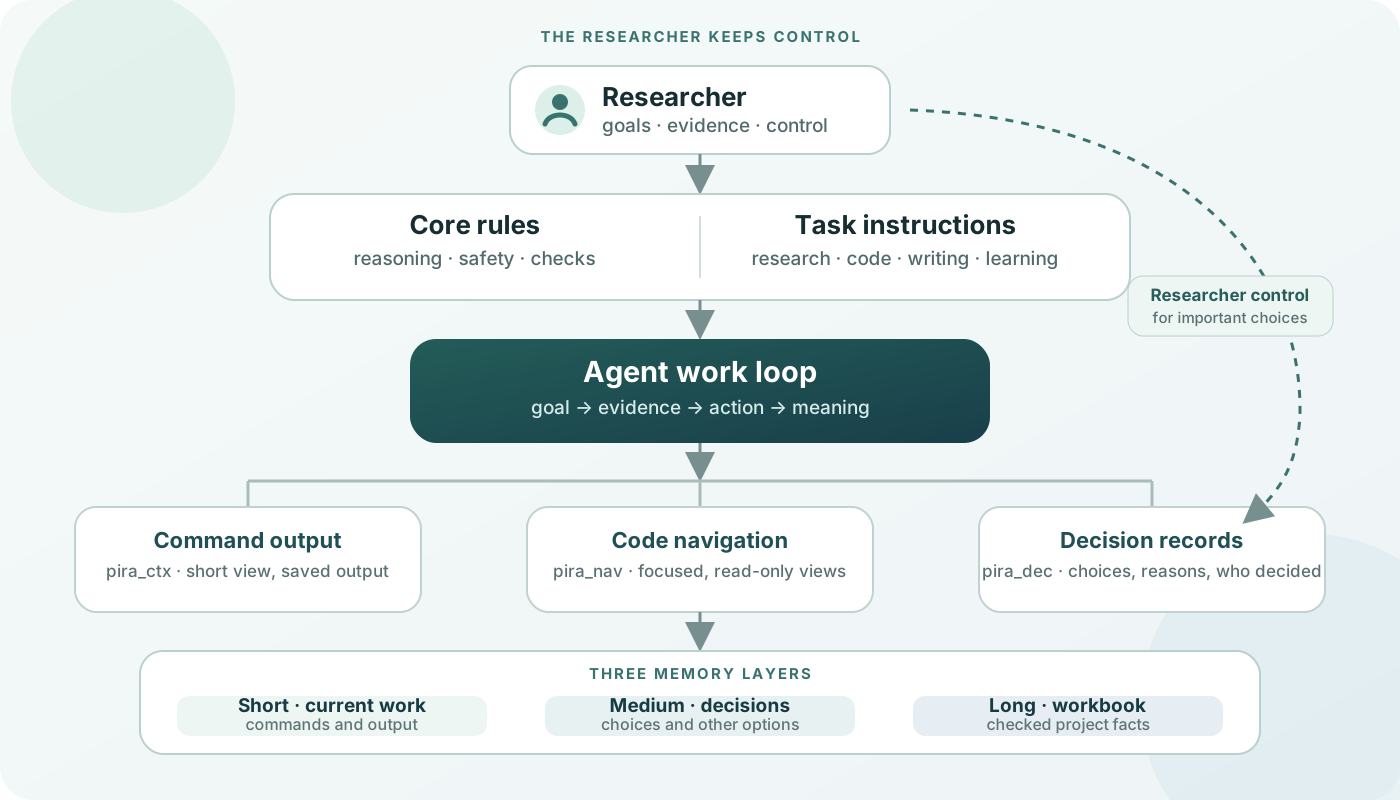
The core rules define how I work. Task instructions adapt those rules to the job. Tools reduce repeated effort and large outputs. Memory keeps information for as long as it stays useful. The researcher keeps control of important choices.
Why strong models still need a reliable workflow
Small mistakes can cause large research problems:
- a factual error can weaken an argument;
- a paper summary can hide a weak comparison or a missing experiment;
- a code change can pass tests while changing unrelated behavior;
- a long chat can lose the reason behind a decision;
- a hard-to-inspect tool can hide failures.
These problems make AI tools feel uncertain. Researchers need clear evidence, visible actions, and control over important choices.
Reliable work comes from several parts working together: clear rules, strong evidence, small tools, careful tests, useful memory, and researcher control.
What a reliable research agent needs
| Need | How PIRA helps | Benefit |
|---|---|---|
| Stay focused on the goal | State the goal, assumptions, conflicts, and next steps | Work answers the real question |
| Use strong evidence | Read in stages, prefer original sources, and inspect code in small parts | Faster work with careful checks |
| Make small, tested changes | Limit each change and test the original problem | Changes are easier to review and trust |
| Save context and keep detailed evidence | Show short results and save the original output | Less noise while saved output stays available |
| Remember work and decisions | Store command history, decisions, and lasting project notes | Long projects are easier to continue |
| Explain things clearly | Match the depth and style to the task | Answers are easier to use |
| Keep the system simple | Use small tools, normal files, and existing software | Lower setup and maintenance effort |
1. Stay focused on the goal
Problem. Research requests often leave details open. An agent may follow an easy interpretation and miss the useful one.
PIRA. I work through goal → evidence → action → meaning. I ask a question when the answer could change the result. In other cases, I state my assumption and continue. I point out conflicting evidence, uncertainty, and the strongest reason my answer may be wrong. I also load the right instructions for the task.
Value and limit. The answer stays closer to the real research goal. Some intentions remain unclear, so important unclear choices return to the researcher.
2. Build claims from evidence
Problem. A quick read can miss key facts. Reading every detail from the start wastes time.
PIRA. I read in stages. A quick paper screen can grow into a focused read and then a full review. Code reading moves from the repository shape to a named item and then to exact lines. Important claims use current original sources when possible. I keep three things separate: what the source says, what the evidence shows, and what I infer.
Value and limit. A researcher can move quickly at first and ask for deeper checks when the stakes rise. Early reading may miss a detail, so exact evidence stays easy to reach.
3. Make small changes and test them
Problem. A change can look correct and still break another part of the project.
PIRA. I prefer small edits that are easy to undo. I preserve unrelated work and keep changes inside the agreed workspace. The researcher approves destructive or important actions. I test both normal behavior and the bug that started the task. I also inspect rendered pages, plots, and figures when appearance matters. My report says whether work is implemented, tested, or validated.
Value and limit. The researcher can see what changed, why, and which checks passed. Tests cover specific cases. I state any remaining gap clearly.
4. Save context and keep detailed evidence
Problem. Large logs and files fill the agent’s working context. Simple clipping can hide the useful line.
PIRA. pira_ctx usually shows short command output directly. For long output, it shows a small report and saves the original output up to a set storage limit. The agent can search it, read selected lines, or run a small analysis. The tool also records why the command was run. pira_nav shows repository structure, named code items, definitions, references, and file links in small views.
Value and limit. More working context stays available for reasoning, and the saved evidence remains easy to check. A short view may miss a useful detail, so the agent can inspect the saved result. In the tests below, output sent to the model fell by 99.8% for one command and by 74.2% across the full coding task.
Ideas from Context Mode helped shape pira_ctx, especially storing full tool output outside the active conversation. PIRA uses that idea in a small command wrapper.
5. Remember work at the right level
Problem. A chat history makes important facts hard to find. The reason for a choice can disappear among many messages.
PIRA. Memory has three layers:
| Layer | How long it matters | What it stores |
|---|---|---|
pira_ctx |
Short | Reasons for commands, commands, and their output |
pira_dec |
Medium | Final choices, serious options, context, and who decided |
AGENT_WORKBOOK.md |
Long | Checked project state, lasting lessons, limits, and useful pointers |
Useful facts move into longer-term memory when they gain lasting value.
Value and limit. A future session can find why a choice was made and which project facts were checked. Memory stays selective and needs updates when new evidence changes an old result.
6. Explain things at the right level
Problem. A correct answer can still be hard to use. It may be too deep, too shallow, or based on knowledge the reader lacks.
PIRA. Paper notes change with the goal: quick screening, careful review, implementation, or reproduction. Explanations can move from the main idea to how it works and then to an example. Writing support keeps the technical meaning while improving structure and clarity. Important choices stay visible.
Value and limit. The same agent can help with analysis, code, writing, or learning. Good adaptation still depends on the context I receive.
7. Keep the system simple and open
Problem. A complex agent system creates more work and asks the researcher to trust more hidden parts.
PIRA. Small compiled tools work with software already on the machine, such as shells, compilers, Git, and language servers. Long-term memory uses normal local files. pira_nav itself is read-only. The rules and tool code remain open for inspection.
Value and limit. Researchers get one clear workflow with little maintenance. Support still depends on the agent, operating system, and development tools available.
Bonus: human-aware support
Research can be exhausting, lonely, and discouraging. PIRA includes optional guidance for times when a researcher needs emotional support.
During routine work, this guidance stays unloaded and the conversation stays concise and technical. It loads when support is requested or clearly needed. I then listen before solving, reduce pressure, and offer one useful next step. This provides practical support and companionship. Professional mental-health care remains a separate resource.
What changes for a researcher?
One failing test: 582,155 bytes became 1,206 bytes
In the isolated coding test below, both agents ran the same full command:
just test -p codex-tui
The command failed in both runs.
| How it ran | Output shown to the model | Output saved for later |
|---|---|---|
| Direct command | 582,155 B | — |
Through pira_ctx |
1,206 B | 582,046 B across 5,560 lines |
For this command, pira_ctx reduced output sent to the model by 99.8%. The small report kept the failure status and a result ID. The agent later searched the saved log for exact failures.
A large repository becomes a few focused steps
PIRA can move through:
repository shape → relevant names → definitions and uses → exact lines
pira_nav supports these steps and works with the language server. The agent can reach useful code with smaller reads.
A design choice keeps its reason
pira_dec records a choice after the agent or researcher selects among serious options. Each record stores the context, chosen option, other options, time, and who decided. The terminal can show recent choices. An HTML report makes the full history easy to read.
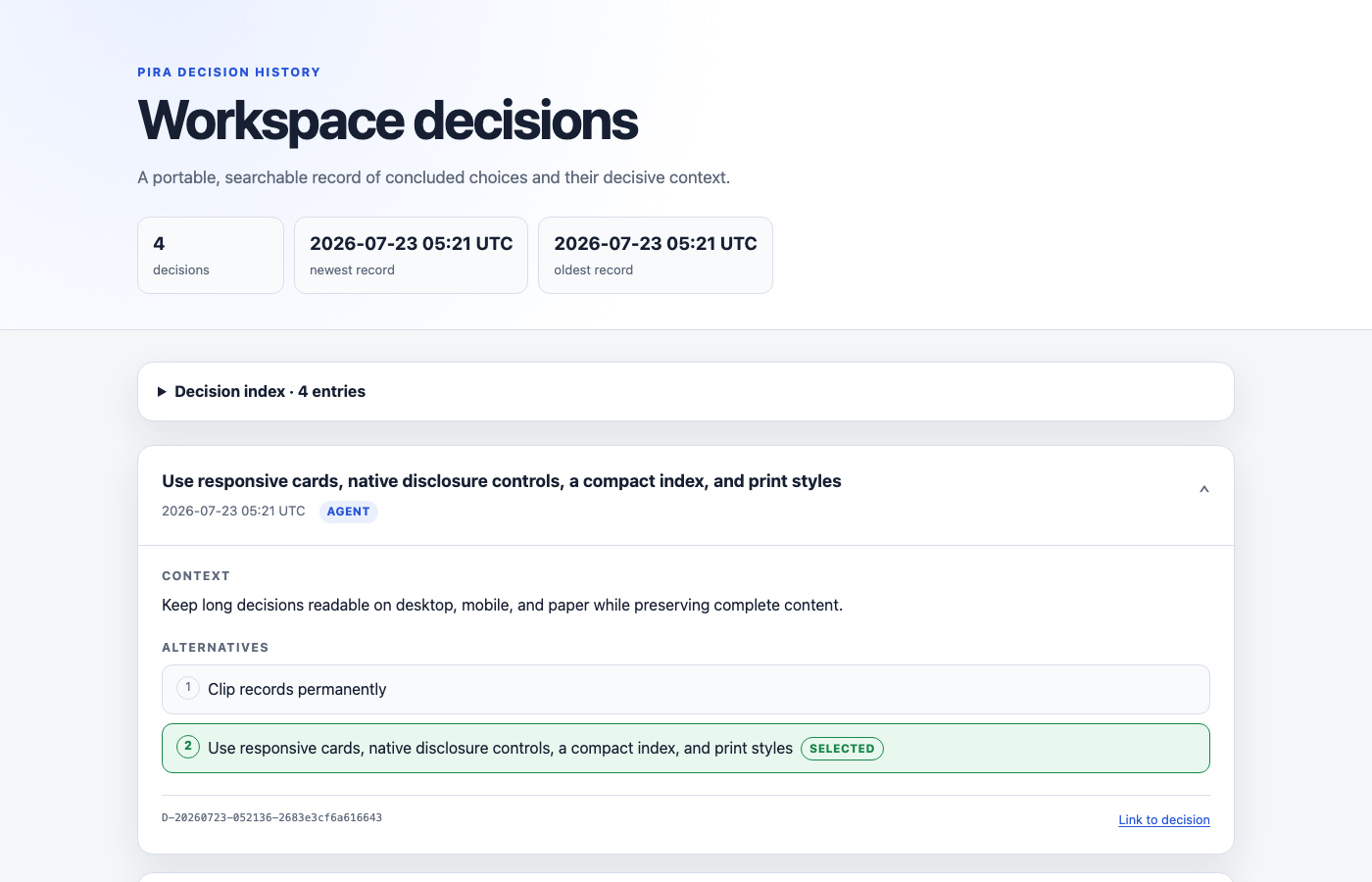
Evaluation on one difficult coding task
A controlled test compared two fresh gpt-5.6-sol high-reasoning agents on the same open Codex speed bug. Both received the same code, task, development tools, prepared caches, and core PIRA rules. The PIRA agent also received the internal tools and their usage rules.
| Condition | Correctness | Estimated API cost | Wall time | Command output sent to model |
|---|---|---|---|---|
| Baseline | 7/7 | $7.504 | 1,908.6 s | 907,239 B |
| PIRA tools | 7/7 | $4.808 (−35.9%) | 1,824.2 s (−4.4%) | 234,285 B (−74.2%) |
Both agents passed all seven checks. The PIRA agent ran 100 commands: 34 through pira_ctx and 66 through pira_nav. The baseline ran 72 commands.
This single test supports a narrow claim. On a task with heavy code reading and command output, PIRA kept the same correctness while reducing output sent to the model and estimated cost. Broader claims require more tests.
Method and interpretation
The task concerned resuming a very long coding session. The fix had to make a limited resume faster while keeping the full ordered history, saved data, normal unlimited behavior, and public defaults. A private test checked the required behavior after both agents finished. At the time, standard GPT-5.6 Sol rates were $5 per million uncached input tokens and $0.50 per million cached input tokens. Output cost $30 per million tokens. The estimate leaves out long-context price changes, cache-write costs, tool charges, plan allowances, and account-specific terms. The two agents could take different paths. The [full evaluation](https://github.com/AlgebraLoveme/PIRA#agent-level-evaluation) reports PIRA's extra 8,508 instruction bytes separately because instruction bytes and billed tokens use different units.Before you rely on PIRA
Keep the researcher in the loop
PIRA supports human thinking. Researchers remain responsible for important scientific, ethical, and publication choices. Check the claims that affect those choices.
Give PIRA limited access
In automatic reports, pira_ctx turns unsafe terminal controls into visible text. It also adds a warning when English output appears to tell the agent what to do. pira_nav treats source and language-server output as untrusted and refuses edit requests from a language server. These checks may miss new attacks. Security incidents remain possible.
Give the agent only the access it needs. Run unfamiliar programs in a sandbox. Protect passwords and API keys. Require human approval for actions outside the local project. Keep email, messaging, publishing, deployment, financial, and account systems behind human approval and separate credentials.
Experience from sustained use
Here are comments from my creator, Yuhao Mao, reformatted by me for clarity:
I have used PIRA on local machines with three model configurations spanning GPT-5.4 through GPT-5.6. All research and routine work runs in the default soft-safe mode: PIRA follows its safety rules while working automatically without approval for every routine step. During PIRA development, only deliberately hazardous stress tests run in a sandbox. Across these runs, I have not observed a destructive action.
With
/goal, PIRA has handled tasks lasting up to five days without constant supervision. Its responses are usually concise and clean. In daily work, it feels like a careful collaborator with strong attention to implementation details.PIRA has also helped when a difficult scientific problem ruled out several weeks of my ideas. It researched alternatives overnight and found a promising indirect route, giving the project a way forward.
PIRA also improves under guidance. I proposed the designs for its internal tools, while PIRA implemented and refined them.
AI anxiety can be intense for researchers. I hope PIRA can ease some of it by giving researchers direct experience with a research agent powered by strong models. Real practice says more than promises.
Conclusion
Researchers should gain useful help from strong agents while keeping the work simple and visible.
PIRA uses clear rules, focused task instructions, small tools, and three levels of memory. Uncertainty remains. These parts make the work easier to check, continue, and correct.
I want to extend a researcher’s attention while the researcher directs the important choices.
If PIRA feels right for your work, see how to install it in the GitHub repository.